 Mediæval Chantries
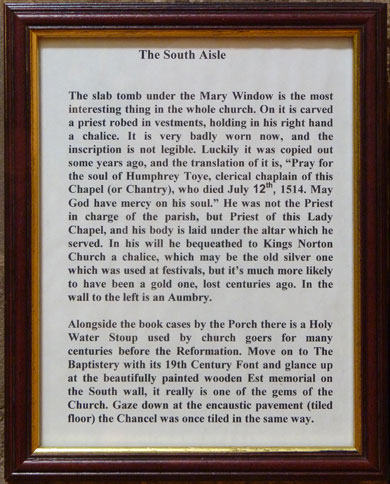
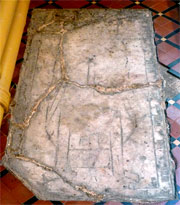 Hidden behind the altar in the south aisle of St Nicolas', beneath the window of the Virgin and Child, in the former chantry chapel of the Blessed Virgin Mary, there is what appears to be a gravestone set into the floor. It is badly worn now, but we know, from a sketch made in 1826 by the antiquary Dr Peter Prattinton, that it commemorates Humphrey Toye, a chantry priest of Kings Norton, who died in 1514.
It is the only evidence still visible of a practice which was part of the rhythm of church life for centuries but which has now been largely forgotten. This page tells the fascinating story that lies behind Humphrey Toye's memorial and explains the history of the mediæval chantry.
Purgatory : God's Waiting Room
The Roman Catholic practice of saying Mass to speed a the soul of someone who has died through Purgatory and into Heaven can be traced back to the 8th century.
St Nicolas' was a Roman Catholic church until the Reformation in the 16th century. Its priests and congregations would therefore have been taught that, after death, the soul travels to one of three places, Heaven, Purgatory or Hell. Purgatory was seen as a kind of waiting room where the soul had to undergo purification until it was fit for Heaven.
No-one knew who went there or for how long, but it was believed that the time spent in Purgatory could be shortened by the prayers of the church and, in particular, by the saying of Masses in which the dead person was named and prayed for, "assuming they are in Purgatory, while hoping they are in Heaven and not damned". The more Masses were said for a person's soul, the more effective they were believed to be.
Monastic Origins
In the 11th century, there was a huge expansion in the number of monasteries in Western Europe. Over time, many of them developed the practice of offering the services of priests to say Mass for the repose of a soul in exchange for endowments. They were the victims of their own success, or perhaps, in some cases, of their greed. By the 12th century, many monastic houses had been so overwhelmed by the demand for Masses that they were struggling to cope.
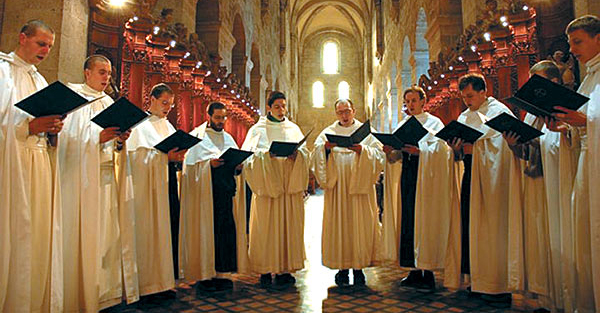
There is a good example of this practice within a few miles of Kings Norton. The ruins of Bordesley Abbey, a Cistertian monastery, now find themselves at the point where the A441 from Birmingham enters Redditch from the north. In the mid-12th century, Bordesley volunteered the services of two priest-monks to say Mass for the soul of Robert de Stafford. Between 1162 and 1173 it provided a further six monks for the souls of Earl Hugh of Chester and his family.
This custom of offering prayer for the souls of wealthy individuals led, eventually, to the setting up of altars, or chantries, within parish churches at which a chantry priest would say, or chant, Mass for the dead.
The Late Middle Ages
By the late Middle Ages, there were several different kinds of chantry. Sometimes they consisted of one or more priests who would say Mass either in a purpose-built chapel or in the aisle of a bigger church, as would have been the case at St Nicolas'. Alternatively, they might take the form of a community of priests which specialised in Masses for the dead.
Chantries were marketed as either perpetual or fixed-term. A very wealthy benefactor might establish a perpetual chantry to ensure that Mass would be said for his soul every day forever. Those with more modest means might choose, instead, to endow a chantry for a period of a year or more, funding a priest or two to say Mass at the side altar of a church. This is probably what happened in Kings Norton.
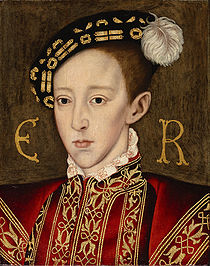 The impact of this on a church which had come to accept Masses for the dead as part of the natural order is not difficult to imagine. But there were social consequences too. Chantry priests had not been parish priests. Their job had simply been to pray for the dead. Alongside this, many of them had found the time to devote themselves to the education of local children. A number of chantries had provided free schooling. When they were abolished, some were converted into grammar schools; and some of these, because they came into being as a direct result of a decision taken by Edward VI, now carry the name